

Charles Pravaz
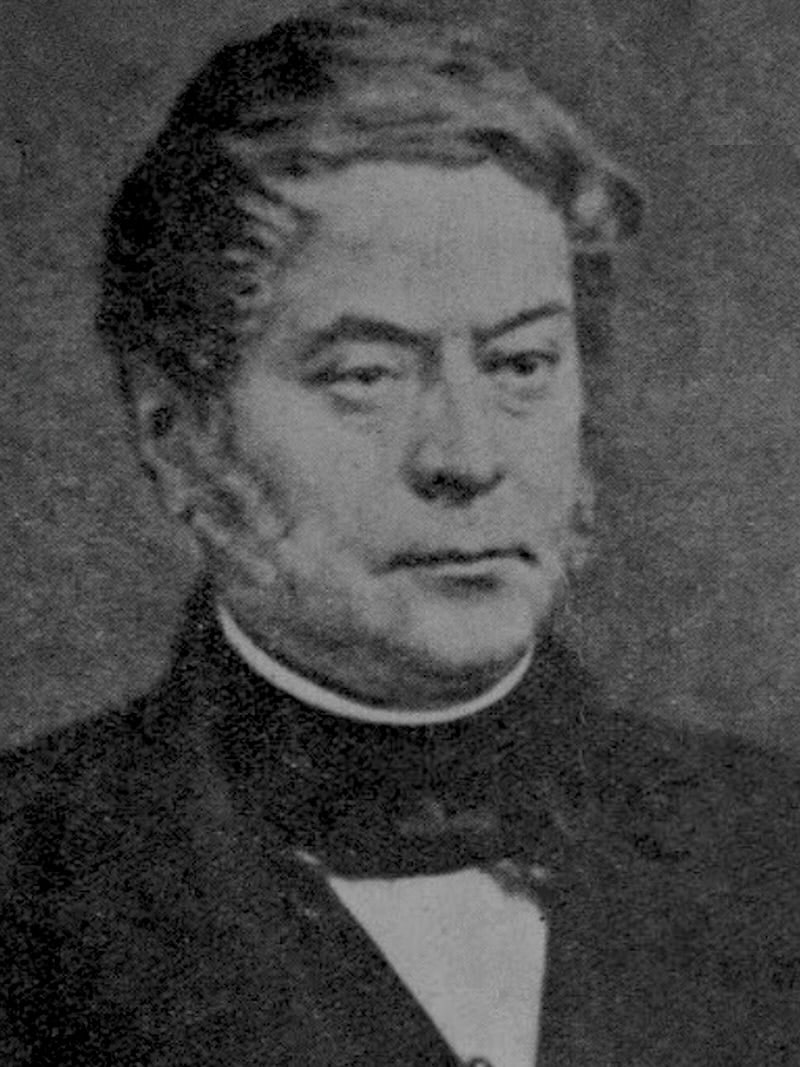
Charles Gabriel Pravaz (1791–1853) was a French orthopaedic surgeon
Pravaz is best remembered for the Pravaz syringe. The eponymous term rests on a syringe commissioned from Charrière in 1852 for the controlled injection of perchloride of iron into arterial aneurysms. His original instrument combined fine cannulation with screw-driven, dropwise injection.
The syringue et aiguilles de Pravaz became attached to broader hypodermic practice only after his death, as Charrière, Lenoir, Béhier, Mathieu, Wood, Ferguson, and others refined syringe design and popularised therapeutic injection. Pravaz did not invent the hypodermic syringe, but was a key figure in the development of controlled injection.
Biographical Timeline
- Born March 24, 1791 at Le Pont-de-Beauvoisin, Isère, France.
- 1801–1805 – Educated with his brother by two uncles, one a former Benedictine monk and the other a former Jesuit; both brothers later entered the Petit Séminaire de Chambéry.
- 1809 – Travelled to Grenoble to study mathematics.
- 1815 – Left the École Polytechnique after the death of his mother from tuberculosis and turned toward medicine.
- 1824 – Awarded his medical doctorate with a thesis on laryngeal phthisis, Recherches pour servir à l’histoire de la phthisie laryngée.
- 1825 – Appointed physician to the Asile royal de la Providence. Observed spinal deformities among young women in institutional care directing his work toward medical orthopaedics.
- 1827 – Published Méthode nouvelle pour le traitement des déviations de la colonne vertébrale, his early work on treatment of spinal deformity. Appointed Chevalier de la Légion d’honneur
- 1829 – With Jules Guérin, founded the Institut orthopédique du château de la Muette at Passy, while also opening a Lyon branch near Sainte-Foy.
- 1835 – Separated from Guérin and settled in Lyon, taking direction of the Institut orthopédique et pneumatique Bellevue, possibly the first, orthopaedic clinic in France.
- 1836 – Made corresponding member of the Académie nationale de médecine.
- 1837 – Elected to the Société nationale de médecine et des sciences médicales de Lyon.
- 1841 – Elected member of the Académie des sciences, belles-lettres et arts de Lyon.
- 1847 – Became corresponding member of the Académie des sciences, belles-lettres et arts de Savoie
- 1851 – Published Institut orthopédique et pneumatique de Lyon, a short account of his Lyon orthopaedic institution.
- 1852 – Travelled to Paris and commissioned Joseph-Frédéric-Benoît Charrière to construct a syringe for injecting perchloride of iron into arterial aneurysms.
- 1853 – Pravaz undertook animal experiments on aneurysm injection, initially with rabbits and then larger animals. Reported as un nouveau moyen d’opérer la coagulation du sang dans les artères, applicable à la guérison des anévrismes.
- Died June 24, 1853 in Sainte Foy-lès-Lyon.
Medical Eponyms
Pravaz syringe and controlled injection
Pravaz is remembered for the Pravaz syringe, but the original device was not designed for hypodermic analgesia or routine subcutaneous medication.
In 1852, Pravaz commissioned the Paris instrument-maker Joseph-Frédéric-Benoît Charrière (1803-1876) to construct a small screw-driven syringe for injecting perchloride of iron into arterial aneurysms, with the aim of producing local coagulation and obliteration of the aneurysm sac.
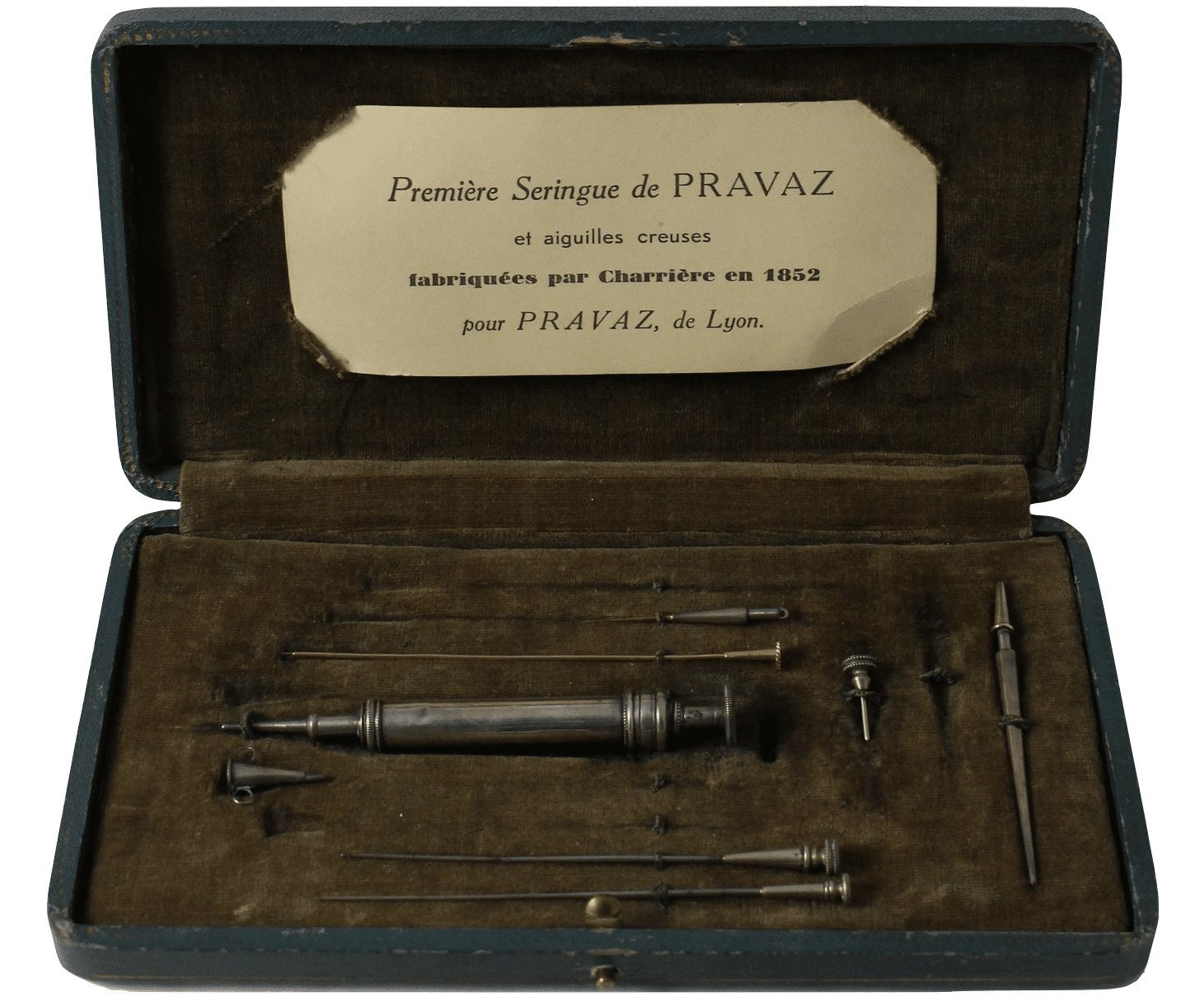
The original apparatus was a controlled-dose device. A fine cannula system, small syringe body, and a screw piston that advanced by a fine thread, allowing the operator to express fluid drop by drop. Injection of ferric chloride into an aneurysm required precision and carried risk if uncontrolled. Lallemand promoted the method after witnessing Pravaz’s experiments, and the procedure entered formal medical discussion in early 1853.
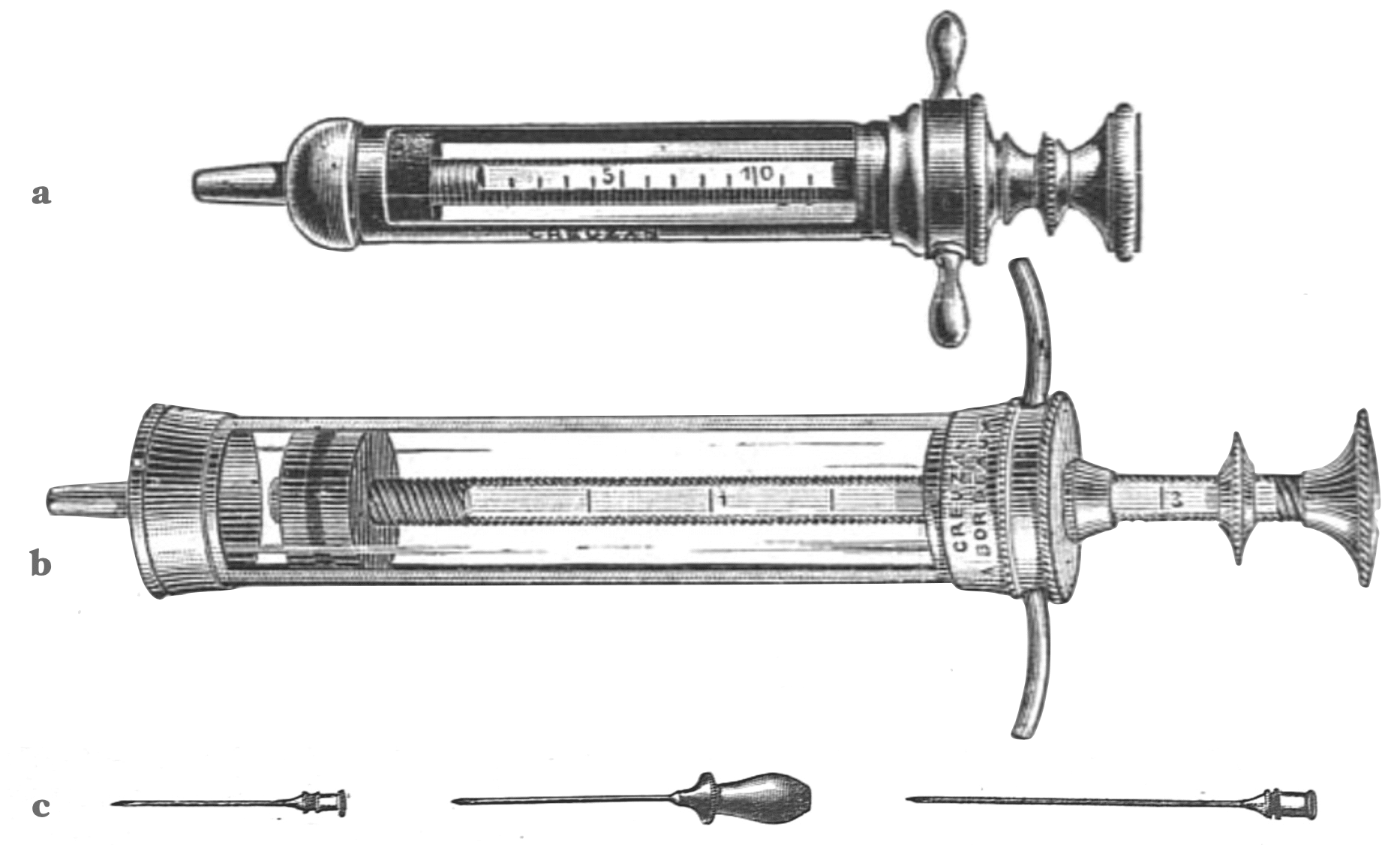
Pravaz’s died in June 1853, before the device had fully evolved and before the hypodermic method became established in France. After his death, Lenoir, Charrière, and others modified the instrument, replacing the metal pump body with glass, improving the piston seal, adding graduated rods and cursor nuts, and developing finer cannulae. These changes made the “Pravaz” syringe increasingly practical as a multipurpose injection device.
From aneurysm syringe to hypodermic eponym
The eponymous term then drifted. From 1859, Louis-Jules Béhier promoted subcutaneous medication in France using modified seringue hypodermique de Pravaz, while Alexander Wood had already used syringe-and-needle injection for morphine in neuralgia from 1853.
Key Medical Contributions
Major Publications
- Pravaz C. Recherches pour servir à l’Histoire de la Phthisie Laryngée. Thèse présentée et soutenue à la faculté de médecine de Paris, le 6 avril 1824.
- Pravaz CG. Méthode nouvelle pour le traitement des déviations de la colonne vertébrale 1827
- Pravaz CG. Mémoire sur les moyens mécaniques propres à prévenir l’absorption des virus. Journal de Chimie Medicale de Pharmacie et de Toxicologie 1828; 4(12): 604
- Pravaz C. Sur un nouveau moyen d’opérer la coagulation du sang dans les artères, applicable à la guérison des anévrismes. Comptes rendus hebdomadaires des séances de l’Académie des sciences 1853; 36(2): 88-90
- Pravaz C. Institut orthopédique et pneumatique de Lyon. 1851
References
Biography
- Munaret. Éloge historique de Charles Pravaz lu a l’Association des médecins du Rhône dans sa séance générale annuelle du 18 mai 1854
- Monument à la mémoire de Pravaz, inventeur de la seringue. La chronique médicale, 1924; 31: 214
- Champeau D. Un Novateur Charles-Gabriel Pravaz (1791-1853). 1931
- Charles Pravaz (1791 – 1853) General Anaesthesia
- Pravaz, Charles Gabriel. BNF
- PRAVAZ Charles Gabriel. Comité des travaux historiques et scientifiques
- Portrait of Charles Gabriel Pravaz (1791-1853), French orthopedic surgeon. Wellcome Collection
Eponymous terms
- Creuzan G. Syringue de Pravaz. Catalogue illustrée. 1900
- Dutar H. Aiguilles de Pravaz. Instruments et appareils. Chirurgie et médecine
- Zakon SL.The centenary of the hypodermic syringe 1853-1953. AMA Arch Derm Syphilol. 1953;68;(5):591.
- Lépine P, Voinot J. Une brève histoire de la seringue. Histoire des sciences médicales, 2010; XLIV: 49-53
- Jean-Pierre Martin. La seringue hypodermique de Pravaz : mythes et réalités. 2024.
Eponym
the person behind the name

BA MA (Oxon) MBChB (Edin) FACEM FFSEM. Emergency physician, Sir Charles Gairdner Hospital. Passion for rugby; medical history; medical education; and asynchronous learning #FOAMed evangelist. Co-founder and CTO of Life in the Fast lane | On Call: Principles and Protocol 4e| Eponyms | Books |